



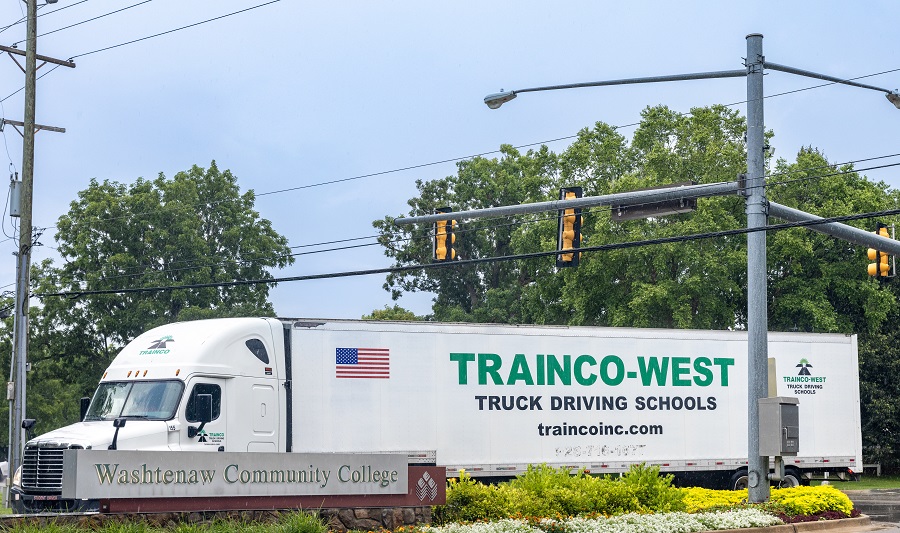

In a training course outside Trainco Inc. in Lansing, Sean Dixon was looking Tuesday in the rearview mirror of a semitrailer, trying to carefully back the trailer into a marked-off section.
A training cone fell along the way. But Dixon was undeterred.
“This will be good,” said Dixon, 44. “I wanted to see more of the country.”
Like that cone, Dixon’s job security toppled in December when he lost his job as a sewer repair foreman and faced life without an income, health insurance or a way to pay his mortgage.
|
| Truck driving student Chris Claytor drives a rig on the practice lot at Trainco Truck Driving School in Lansing. / Rod Sanford | Lansing State Journal |
But the Linden man has now steered into a new career — truck driving. He joins thousands of others nationwide in filling what experts say is a growing shortage of drivers.
Despite a national unemployment rate topping 8 percent, trucking companies are having difficulty recruiting drivers. According to the U.S. Bureau of Labor Statistics, there will be 330,000 heavy truck driver vacancies or positions added nationwide between 2010 and 2020.
In Michigan, officials project there will be a need to fill 1,460 positions for driving semitrailers and heavy trucks between 2011 and 2013 — a 2 percent rise in the total number of such jobs, said Mark Reffitt, a regional economic analyst for the state.
“They’re growing because the economy is improving,” said Doug Stites, CEO of workforce development agency Capital Area Michigan Works.
“It declined during the recession but it’s back up again.”
Some truck driving schools — such as Perrysburg, Ohio-based Trainco Inc., which has six schools in Ohio and Michigan, including the one in south Lansing — have been seeing increasing enrollment in recent years, but still can’t keep up with the demand.
Some Michigan colleges, including Baker College, offer truck driving as a course offering. Baker offers the 20-week course at sites in Lake City, Holland and Flint, and has seen significant growth in recent years. It graduated more than 200 students last year, said Tim Baker, program director for the college’s Cadillac campus, near Lake City.
“Companies are concerned about filling those positions,” said Michael Moscinski, vice president of Trainco Inc.
“The shortage is clear across the country and we’re here to help fill that. It’s a good time to come into the industry.”
Despite the nation’s high unemployment rate, many jobless are dissuaded from pursuing trucking because of its long hours and sometimes weeks spent away from home on the road during cross-county runs, Moscinski said.
“It’s very difficult on the family life,” Baker said. “It’s a tough, hard job.”
Also daunting for prospective applicants is the high course fee — often ranging between $4,000 to $6,000 for four to six weeks of training.
Davenport University charges $7,800 for a more intensive 20 weeks of training that college officials say makes graduates more competitive in the marketplace.
In Michigan, some tuition assistance for applicants is available through the federal Workforce Investment Agency, Stites said.
Randy Turco, campus manager for Trainco’s Lansing location, said the quick turnaround in training and job placement has been a draw for who many who have signed up.
Entry-level truck drivers in Michigan earn $35,000 or more annually, and Davenport and Trainco claim to have a 90 percent or higher job placement rate for those who complete the course.
Moreover, Baker said some companies are offering signing bonuses of several thousand dollars to qualified drivers entering the workforce.
He said he hoped it will help make the profession more viable in the eyes of young people seeking a livelihood.
“There is a social stigma to (trucking). No kid tells their parents they want to grow up to be a truck driver,” Baker said. “We teach pride to our students.”
Article Source: Lansing State Journal |